"We are drowning..." - From Lisbon, Milan to Tirana, "The Guardi...
/ 2026-10-18 23:13:32Focus


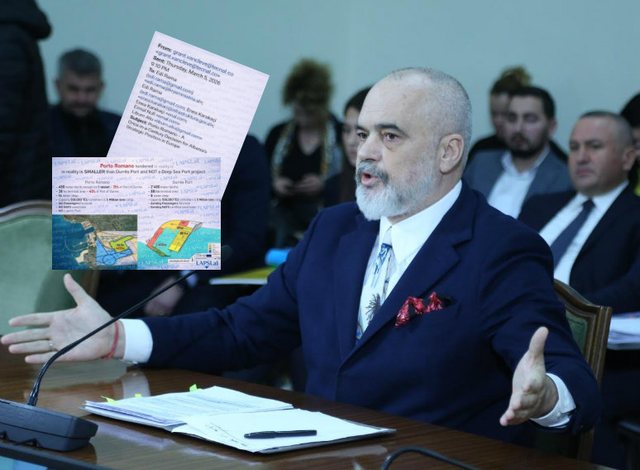
With only a few days left before the deadline for announcing the bid for the new port of Durres in Porto Romano, a message has arrived at Prime Minister Edi Rama's email address advising him to take a step back.
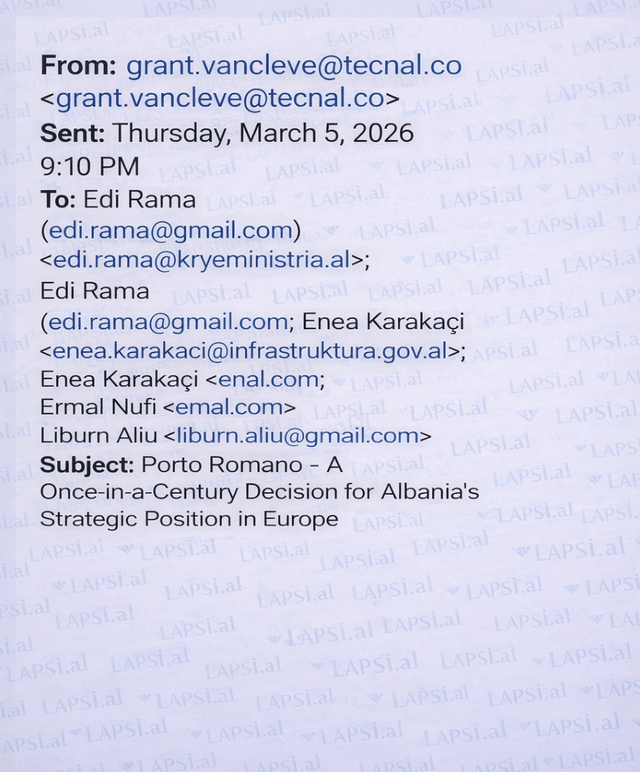
The email was sent by Grant Van Cleve, head of the American Chamber of Commerce in Albania.
In terms of the topics it addresses, the interests it takes into consideration, and the way it constructs the argument, the message goes beyond the opinion of an entrepreneur.
It touches on regional infrastructural and economic developments, emphasizing security and NATO's strategic logistics.
From the content, the message clearly appears to have been conceived in strategic circles in Washington and hints at an offer that leaders of small countries cannot refuse.
The project for the new port in Porto Romano arose as a need after the "Durres Marina" project, where Arab businessman Muhamed Alabbar was brought from Dubai to build a complex of towers and a luxury marina, which envisages the relocation and demolition of the existing port.
But in the panorama that Grant Van Cleve sketches, building a new port is not a decision made with the drop of a pencil, as part of a momentary bargain.
In the email located in Prime Minister Rama's email and published exclusively by Lapsi.al, the Americans raise the issue on another strategic level, titling the message: " Porto Romano - A once-in-a-century decision for Albania's strategic position in Europe. The strategic dominance of Albania's connectivity ."
“A small port in Durres would fail Corridor 8”
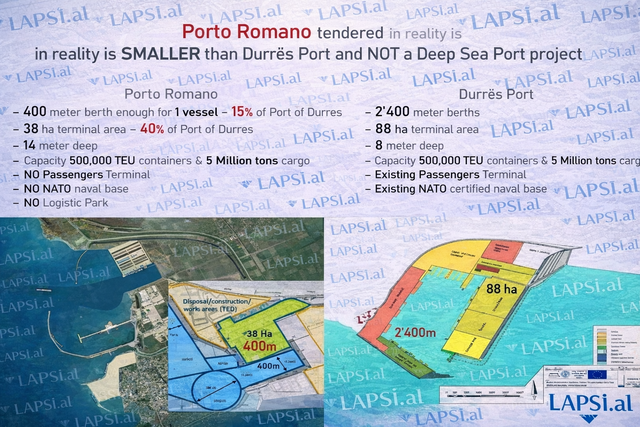
The sketch above is included in the email to show the limited capacities of the new Port at Porto Romano.
The first part of the published message focuses precisely on the strategic importance of the new port of Durres for the entire region.
Van Cleve describes the construction of the new port as “ a historic opportunity to reshape the logistical geometry of the Balkans ,” which would give Albania the opportunity “to shift the economic gravity of the region and achieve strategic dominance in connectivity through the construction of high-capacity corridors anchored in Porto Romano.”
Precisely underlining the importance of the moment where the country is, the head of the American Chamber of Commerce adds: "The decision planned for March 9 regarding Porto Romano represents a national strategic moment that will shape Albania's geopolitical and economic position in Southeast Europe for decades."
In fact, the figures accompanying the email do not leave much room for interpretation. According to the document, the current project for Porto Romano envisages a very small port compared to the capacities of other ports in the region.
The email states: "The current Porto Romano project is extremely small, 400 meters of quay wall and 38 hectares of port area."
For comparison, the port of Piraeus has a quay with a length of 24 thousand meters, Thessaloniki, 6600 meters, and Durrës 2400 meters.
But what is the purpose of this email?
What is essentially being requested of the Albanian government for a project that at first glance seems like an already closed deal?
Essentially, the US seeks to protect the Corridor 8 project, a corridor of strategic importance for transport and movement in the region. According to the argument presented in the email, a port with limited capacities in Durres would seriously jeopardize this entire project.
The message states: “ Ports are built once a century and strategic mistakes made in their construction can affect the fate of a country for a century. If Porto Romano is built on the current limited scale, Corridor 8 will fail structurally, and freight flows to Southeast Europe will continue to be captured by Piraeus and Thessaloniki, leaving Albania outside the main Mediterranean logistics system for the next century .”
According to Van Cleve's analysis, a small port at Porto Romano would have direct consequences for the entire transport architecture in the region. A reduced project would result in very few ships berthing and, consequently, Corridor 8 would lose its real function.
The email clearly states: "Transport corridors follow ports, not the other way around."
It is further explained : “ A small port cannot generate the volumes of goods needed to support a large east-west logistics corridor like Corridor 8. Corridor 8 will not follow a small port. If Porto Romano remains small, regional cargo will continue to pass through Piraeus and Thessaloniki .”
The Americans' offer: NATO builds the new port in Porto Romano
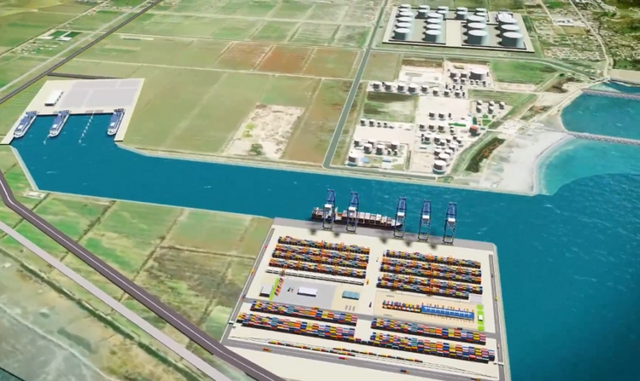
The geopolitical dynamics of the region are also described in this context. Van Cleve notes that although Corridor 8 has been a strategic objective for more than three decades, not all actors have an interest in its realization.
The email states: “Not all geopolitical actors share the same interest in developing a strong east-west logistics axis in the Balkans. Some actors benefit from maintaining existing north-south logistics flows centered around other Mediterranean ports. Infrastructure in geopolitically contested regions is never neutral .”
The demands presented by the American side are straightforward.
First, the postponement of the tender for Porto Romano is requested, so that the project can be reviewed based on economic and strategic parameters that would guarantee the full functioning of Corridor 8.
At the same time, the project must also take on a new dimension: that of security.
The message states: " We respectfully request that the tender for Porto Romano scheduled for March 9 be postponed and reviewed based on the latest NATO and Corridor 8 requirements ."
Van Cleve goes further in the email that Lapsi.al has obtained in full, offering an alternative development model: “ A larger Porto Romano within this year, co-financed by partners from the United States and Italy and implemented by key strategic suppliers from the US, Italy, the Netherlands and Turkey .”
What is striking about the request signed by the head of the American Chamber of Commerce is that the offer is not presented as an isolated American initiative.
His proposal includes Italy, the Netherlands and Turkey, three countries with weight in NATO and in the strategic architecture of the region.
This immediately shifts the meaning of the message from an entrepreneur's advisory letter to a much broader strategic signal.
It is understood that the message was not simply drafted in Tirana or in the offices of a business organization, but was conceived in a much wider circle of decision-makers.
Chances are that this email to the Albanian Prime Minister's email is a message that, in terms of the language and content of the offer, clearly bears the stamp of Washington.
This becomes even more evident in the part where Van Cleve offers a complete international package for project development.
The proposal continues: “ We can secure the best American engineering firms to assist in the design review of Porto Romano, the railways, highways and all dual-use infrastructure of Corridor 8, to be built to NATO standards, in full coordination with NATO, and to also secure additional funding from NATO .”
By bringing NATO into play, the issue automatically moves to another level, that of strategic security.
Van Cleve emphasizes: “ A deep-water Porto Romano, connected to Corridor 8, would significantly strengthen NATO’s mobility and resilience in Southeast Europe .”
Can the Albanian government refuse this offer?
The question that now arises is straightforward: can the Albanian government reject such a proposal, at a time when the Porto Romano project is linked to an offshore company registered in Cyprus?
Meanwhile, behind the scenes there are developments that make this story even more complicated.
A few days ago, the appointment of a 24-year-old as deputy general director of the Durrës Port Authority was made public, a position that had not existed for several years.
Rubin Rredhi was appointed by former Minister of Infrastructure Belinda Balluku, a move that was interpreted by many as an attempt to find another dummy signatory for controversial projects.
Meanwhile, SPAK has launched a new investigation into this matter, while a few days ago the tender documents were seized at the offices of the Durrës Port Authority.
At the end of the message obtained exclusively by Lapi.al, Van Cleve summarizes the dilemma with a few simple strategic questions: “ The question is simple : Will Albania depend on Piraeus and Thessaloniki?
Will the Balkans and the region depend on Porto Romano?
A small Porto Romano will remain a secondary national port.
A large Porto Romano could reshape Albania's strategic role in Southeast Europe ."
However, from the way it is presented on paper, the debate over the new port in Porto Romano is not simply a technical debate over a few meters of quays or a few hectares of terminals.
The Americans are framing this as a debate about the role Albania wants to have on the economic and geopolitical map of the region.
At one extreme stands the current project, tied to political bargaining and narrow economic interests.
At the other extreme lies an offer that places the new port in a much larger strategic game, where European transport corridors, NATO interests, and logistical rivalry in the Mediterranean mix.
The decision then rests with Rama.
But his position at the head of the government has been shaken in recent months, because at the moment it is sanctioned: a judge's decision is enough to suspend a prime minister from office./ Lapsi.al