


"Condemned" protesters?! Who trapped Rama inside the Prime Minis...
/ 2026-10-23 16:02:00Focus


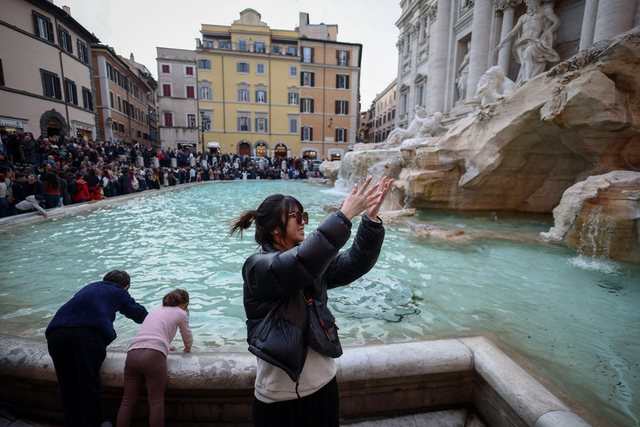
One of Italy's most popular attractions that gathers more than 21 million tourists every year is, without a doubt, the Trevi Fountain (Fontana di Trevi) in the historic area of Rome.
The Trevi is the largest baroque fountain in the city, the construction of which dates back to the 18th century AD. It is also 25.9 meters high and 49 meters wide. The fountain was designed by Italian architect Nicola Salvi and completed by Pietro Brazzi (1732-1762).
The name of the fountain (Trevi or Tre vie), means "three roads" as the intersection of three ancient Roman roads, as the attraction is located in the center of Via De' Croricchi, Via Poli and Via Delle Muratte.
Furthermore, the site of the monument was the end of Rome's Aqua Vigo aqueduct, which – along with dozens of others – supplied the city with water for more than four centuries.
As is known, the Trevi Fountain has a unique ability to "enchant" its visitors, making them fall in love with Italy.
However, the most popular tradition involves tossing coins accompanied by wishes. Some argue that this particular habit was adopted after the release of the 1954 romantic comedy "Three Coins in the Fountain" directed by Zan Negulesko, where Frank Sinatra performs the film's title song.
Also, a scene from Federico Fellini's La Dolce Vita (1960) was filmed there, with Anita Eckberg entering the fountain at midnight, inviting Marcello Mastroianni to follow her. However, it seems that this particular "ritual" had started before the screening of the two films.

So what happens if someone throws a coin into the fountain?
According to legend, with a coin, you will be lucky and expected to return in the future to the "Eternal City", as Rome is otherwise called. By tossing two coins, you can fall in love with a beautiful Italian, while with three coins there is the possibility of marrying the person you meet.
Those couples, of course, visiting Rome for a romantic trip, then they are satisfied with the first option. Also, near the fountain there are signs warning tourists that entering the water is prohibited, as well as the theft of coins.
However, there is a specific method that must be followed for coin tossing, which is as follows: According to tradition, visitors stand with their backs to the monument and toss the coin into the water with their right hand, from the side of their left shoulder. Also, since it is a popular destination for tourists and can get crowded, it would be good to choose to see the fountain up close in the early morning or late at night, as its lighting is amazing.
What is the process to collect coins?
Workers belonging to the Municipal Electricity and Water Agency (ACEA) are tasked with collecting the coins from the fountain twice a week, while the water is drained twice a month to clean the site. Specifically, municipal workers use brooms to create "stacks" of coins on both sides of the fountain.

They then "pull" the coins through a flexible suction hose under the watchful eye of the police. After that they are sent to the offices of the international charity organization Caritas, which is part of the Catholic Church. For their part, the Caritas workers spread the buckets of coins on a large table to dry them with a “hair dryer” so that their sorting and counting can begin.

But how much money is raised each year by the fountain?
It is estimated that in 2022 Caritas collected 1.4 million euros from the fountain, while the amount is likely to be higher in 2023.
Thus, the coins aim to support the economically weaker parts of the city, as they distribute food to people in need, while housing and social structures for the homeless are also financed.
In addition, Caritas' "social supermarket" known as Emporium operates near Rome's central station, providing food for low-income citizens.


