


Protests, violence, curfews: From France to Albania, why Europe'...
/ 2026-10-20 23:47:20Focus


Every day, about 90,000 airplanes leave for all directions of the planet. We are already used to flying as they take a train. And yet there are still many clichés and myths about flying and airplanes. Here are 15 questions to ask yourself every time you wear your belt.
From the small hole in the window to the flight attendants' secret rooms
Aircraft are designed to withstand lightning strikes

Lightning strikes every plane regularly, at least once a year. Or, in other words: every 1000 flight hours. However, accidents rarely happen. The most catastrophic accident dates back to 1963 when a Boeing 707 was struck by lightning and crashed in Maryland (USA), while flying from Baltimore to Philadelphia, killing all 81 people on board. In reality, the plane has a metal structure, more or less like our car: leaks flow on the surface of the plane and do not reach the interior, continuing its journey in a vacuum. In addition, today all airplanes have a protection system that prevents fires in the tank.
What are the holes in the airplane windows for?

Anyone who sits in the window seat will probably have noticed a small hole at the bottom of all airplane doors. What is it for? It is called "breathing hole" and its function is very important for safety. Simply put: it serves to better manage the pressure difference outside and inside the plane.
There is no safer seat on the plane than the other

Disadvantages of the safe place. The Federal Aviation Administration (FAA), the federal civil aviation agency, says there is no safer place than another in the event of a plane crash. However, several studies, including one by the American magazine Time (which was analyzed through the aviation accident record of the last 35 years), found that the safest seats are the middle seats in the back rows. "Passengers in the back of the plane have a lower mortality rate (32%) compared to those in the middle (39%) or front (38%)." However, in the event of an accident there are countless variables: therefore it is impossible to determine the "safest place".
The secret rooms of flight attendants

Some airplanes (especially the long-haul ones, the Boeing 777 and 787 Dreamliner) have "inaccessible rooms," actual beds where flight attendants and attendants "disappear" to rest or sleep. The rooms (from 6 to 10 beds) are generally accessible via a hidden staircase and are located above the travelers' heads. There is also a small relaxation area with a TV.
Why do the cabin lights dim during landing?
When a plane lands at night, crew members dim the lights inside the cabin. Why? For a security reason. In fact, in the event of an emergency evacuation, our eyes would have already adapted to the dark, so we would be able to see better once we were outside. Similarly, flight attendants invite passengers to raise the window curtains during take-off or landing to ensure that the passenger is more visible to the outside in the event of an emergency, accident or evacuation. Even relief efforts can look inside and understand that way what is going on.
You don't need both engines to fly
The idea of an engine failing in flight seems scary, but any commercial aircraft with two or more engines can fly with one engine inoperative, i.e. at 50%, 33%, 25% power / depending on the number of engines.
Why are there ashtrays in the bathroom?
It is forbidden to smoke on airplanes, even children know it. However, many aircraft toilets still have ashtrays. Reason? Airlines (and the engineers who design the aircraft) are aware that – despite the many bans – there is always a smoker who will at some point decide to light up a cigarette. He will do it in this relatively limited space like the bathroom, "in a safe place". And an ashtray here serves just that. But remember: smoking on a plane can be very expensive. A few years ago, a passenger on a Ryanair flight from Bergamo to Alghero was fined 2,000 euros for violating Article 1.213 of the Air Navigation Code.
The food is tasteless
Airplane food has a bad reputation. But whose fault is it? From the food or the condition in which we find ourselves, this is an altitude of about 35 thousand meters in a pressurized environment? The answer: it's not necessarily the dishes' fault. Low pressure and humidity (the air is recycled every few minutes in the cabin) dulls the taste of food and drinks, also changing the taste sensation. The very dry air on board causes the nasal mucosa to dry out, essential to help us distinguish aromas and perfumes and understand the flavors of food properly. Tip: Next time, skip the meal and ask for a glass of tomato juice.
For those oxygen masks

In the unfortunate event of a sudden loss of cabin pressure the oxygen masks will automatically pop out of their homes located just above the passengers' heads. They should be dressed immediately and have about 15 minutes of oxygen available. It seems like an awfully short time, but in reality it should be more than enough. Especially for the pilot who will need to bring the aircraft to a lower altitude (below 10,000 feet) where it is possible to breathe normally.
What are those white paths?
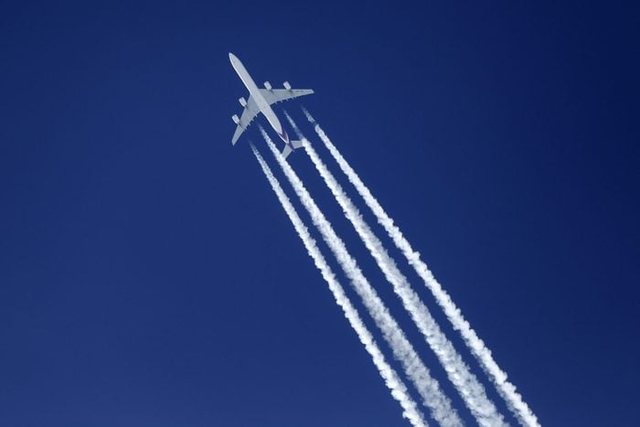
The white trails left by airplanes, which can sometimes be seen looking up into the sky, are not discharged gases. Nor "proof of a global conspiracy". Their technical name is "contrails". Reactors emit water vapor as part of the combustion process. When this hot vapor comes into contact with the cold air of the earth's atmosphere, it creates those white lines.
How many planes are flying now?

According to an analysis made by the FlightAëare portal, last year in the sky of the world there was - on average and at any time - a total of 9,728 planes carrying 1,270,406 people. The heaviest day for air traffic was August 5, 2016, with 12,856 planes carrying 1,590,929 people.
The dirtiest thing you'll touch on a plane

The broken table, full of "flying germs". Although those shelves we use to put food or other things are cleaned after each flight, the level of germs found is quite high: we are at risk of coming into contact with an average of 2,155 units per square inch. In comparison: there are "only" 265 in the bathroom.
The black box is not black
An airplane's black box (“black box”) records conversations between pilots and acquires technical data. But it's not black: it's orange. Perhaps the first black boxes mounted on airplanes were black or black in case of fire. Then they started making them orange, with reflective bands to make them easily traceable in the event of an accident.
"Pilots are served with two different meals"
A different menu is served in the cockpit compared to the passenger. Pilots and co-pilots cannot share what they eat. Reason? In fact, the food of one of them may have something wrong with it. At least that's what a flight doctor revealed in a (heated) Reddit discussion a while back titled: "You who work for airlines, what are the secrets that travelers don't know?"






