


Protests, violence, curfews: From France to Albania, why Europe'...
/ 2026-10-20 23:47:20Focus


To see the pyramids, you may not need to travel to Egypt right away. Namely, one of them is much closer than you think, more precisely in Italy.
It's called the Pyramid of Cestius, it's the only "Egyptian" pyramid in Europe, and it dates from the era when the Romans were obsessed with all things Egyptian, after Egypt became a Roman province, and it still stands today - as part of the Aurelius walls there - on the edge of a very busy crossroads, near the Protestant cemetery in Rome.
The Pyramid of Cestius is supposed to have been built between the 18th and 12th centuries BC. Its height is 36.4 meters, while each side is about 30 meters long. It was built as a tomb for the man it is named after, Gaius Cestius Epulonus, one of the Roman officials. The tomb itself is located inside the pyramid and is about six meters long, about four meters wide and about five meters high.
At the time it was built, it was located outside the city center and was surrounded by columns and two bronze sculptures. Over the centuries, the area around the pyramid has changed dramatically, so even today it is surrounded by traffic jams. It was probably saved from destruction by the fact that it became part of the walls of Aurelius between 271 and 275.
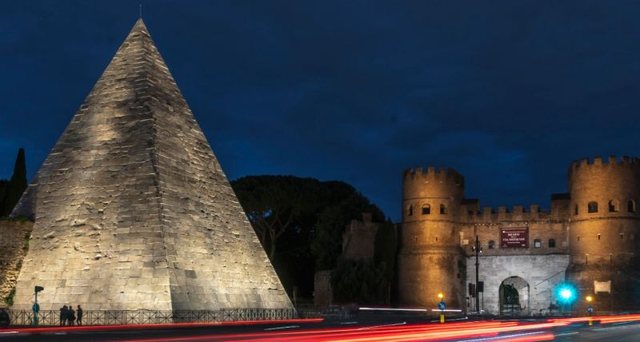
The Pyramid of Cestius, although it was created in the era of "Roman Egyptomania", was nevertheless built at a much sharper angle than the original. Some historians assume that this was the result of inaccurate information coming from the Egyptian front. They see another reason in the Roman construction skills and the use of concrete, thanks to which they could build it at a sharper angle. Others believe that the builders were inspired by the steeper Nubian pyramids. In any case, the pyramid is built with concrete and bricks, and is "painted" with white marble, and has been renovated several times so far.
Besides that of Cestius, there was another pyramid in Rome, which did not manage to survive to the present day – the marble used in its construction, for example, was reused to make the steps of St. Peter's Basilica. It was bigger than that of Cestius, it was located near Castel Sant'Angelo and it was called the pyramid of Romulus. Specifically, both pyramids were mistakenly identified in the Middle Ages as the tombs of the founders of Rome, Romulus and Remus. The Pyramid of Cestius was thus considered to be the tomb of Remus, but the theory fell apart when an inscription was found on the pyramid in 1600 that explicitly mentions Cestius.
In the same period, other Egyptian-inspired buildings, such as obelisks, were erected throughout Rome. Two still stand proudly, although they are not the original places where they were erected. One is located in Piazza del Popolo, and the other in Piazza di Montecitorio.





