How Belinda Balluku is fabricating the rumor about Top Channel's...
/ 2026-10-19 16:19:00Focus


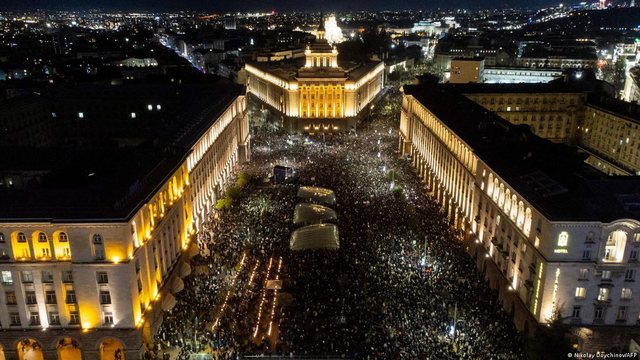
Tens of thousands of people took to the streets of Sofia and other Bulgarian cities on the evening of December 1 to join protests against the ruling coalition's budget plans, forcing the government to abandon them the following morning.
But the crowd also chanted "resignation," due to widespread anger over corruption and economic problems.
Independence Square was filled with people in the largest demonstrations since the 1990s.
Opposition parties met on December 2 to discuss next steps, amid rumors that they too will demand the resignation of the Government and the announcement of early elections.
"This whole situation with the scum that have been in power for 30 years, or more, just has to end. We are the people who have to change this," said Aleksandar Karatov, a protester in Sofia.
Why now?
The immediate focus of the protests was over a budget bill that would increase individual contributions to pensions and social security programs. The demonstrations were called by opposition parties that do not enjoy high public support.
But these budget changes – combined with salary increases for state employees, such as law enforcement officers – appear to have fueled the explosion of long-pent-up anger over corruption and the misuse of public funds.
Karatov told REL's Bulgarian Service that his social security and tax payments are not being managed transparently.
"As a worker, I'm already being robbed. Regularly. And they want to steal even more. I don't want to let them do that," he added.
His stances were echoed by many others, as protesters chanted "The government is the mafia."
The international organization Transparency International ranks Bulgaria as the second most corrupt country in the European Union, after Hungary.
Bulgaria is also the EU's poorest country, according to the bloc's Statistical Office.
It is also among the most politically unstable members of the bloc.
Bulgarians have gone to the polls seven times since 2021 to elect a Parliament that has been paralyzed by a series of unstable coalitions led by various center-right and right-wing parties.
Another protester, Karolina Koleva, told REL that she would accept higher taxes to fund “pensioners, mothers, teachers… healthcare,” but “this money will disappear again into bonuses for different people.”
Is the government at risk?
This is the second time in as many weeks that the government's budget proposals have faced protests. It initially announced it would "revise" the plans after protests on November 28. It has now said it will draft them from scratch.
The scale of the demonstrations on December 1 surprised everyone. Unusually, they did not take place only in Sofia. Crowds gathered in many towns and villages throughout Bulgaria.
Several issues seem to have contributed to this. Some people were angry about Bulgaria's decision to adopt the euro currency on January 1.
There was also visible dissatisfaction with some specific politicians, such as Boyko Borisov, who has been prime minister three times for a total of nine years between 2009-2021, and Deljan Peevski, a lawmaker and oligarch sanctioned for corruption by Britain and the United States.
Neither of them currently holds a government position, but they are leaders of the two parties that make up the governing coalition.
Protester Stoycho Stoychev told REL that the two men are "symbols of the captured state."
He said he had come to Independence Square because of the "anger" of the last 15 years.
This was another factor that prompted people to take to the streets: the fact that politicians like Borisov have been at the center of power for decades.
Another element that added to the momentum of the protests was support for the mayor of Varna, Blagomir Kotsev, who had just been released after spending months in detention on corruption charges that his supporters called politically motivated.
"Democracy has been corrupted and we must restore it," Kotsev told protesters in Varna.
Demonstrators in Sofia, watching his speech on giant screens, chanted "Victory."
Borisov, Peevski, or Prime Minister Rosen Zhelyazkov have not commented on anything so far.
On the evening of December 1, there were several clashes between police and protesters. Bulgarian authorities reported 10 people detained. But, in general, across the country, the rallies were peaceful/ REL