How Belinda Balluku is fabricating the rumor about Top Channel's...
/ 2026-10-19 16:19:00Focus


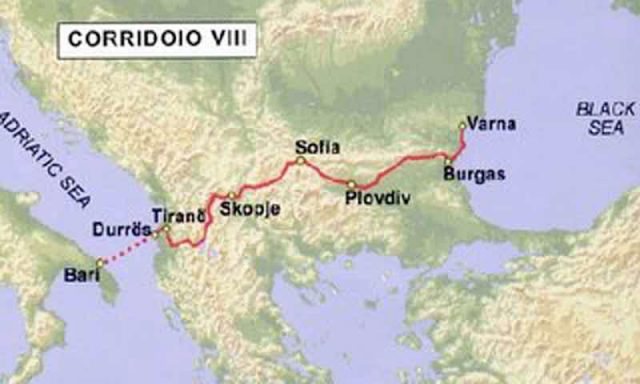
After almost 30 years, the "Corridor 8" project returns as part of the main European TEN-T infrastructure. This classification will commit funds to complete the road axis, railway, ports, etc., with the highest standards of the EU, until 2030. The projects in this axis, at the moment, are chaotic, but Albania, Macedonia and North and Bulgaria have announced this strategic project. The situation of works on the Albanian part of the road and railway. "Corridor 8" is the core infrastructure project in our country, as it will take the flows in ports, airports and logistics to another level.
Albania's infrastructure is facing a new development potential, after the inclusion of "Corridor 8" (Durrës - Përrenjas - North Macedonia, the Albanian part) in the main European TEN-T network by the European Parliament at the beginning of December 2022.
The Trans-European Transport Network (TEN-T) is based on a clear development plan for the main road and rail infrastructure across Europe, including waterways, ports, airports and rail terminals.
The final objective is to close the gaps in infrastructure and the economic empowerment of the regions in Europe by 2030, deadlines which also apply to Corridor 8.
Together with Corridor 10, in the territory of Albania, two important European road lines pass, which will become the reason for the strengthening of all other supporting infrastructure for the movement of people and goods and especially the strengthening of Albanian ports in the Adriatic.
The inclusion in the TEN-T network makes the project financeable by the EU with grants and loans with favorable interest.
Corridor 8 was designed as part of the Pan-European Network at the Crete Conference in 1994, with the aim of being financed and completed in the next 15 years, but later, the project remained in the shadows, due to the development of East- West a little higher than the Mediterranean, driven by China's investments in infrastructure and the priority given to North-South road networks.
Adrian Haçkaj, research director at the Institute for Research and Development (ICD), the main lobbyist for the Albanian part, says that, with the inclusion of Corridor 8 in the TEN-T network, for the first time the infrastructure of the Western Balkans is an integral part of the European corridors and no longer as an extension.
The main footprint of Corridor 8 includes sea and river ports, airports, multi-modal ports, roads and railways, with a total of 1,270 km of rail and 960 km of road.
It runs from the southern Italian ports of Bari and Brindisi to the Albanian ports of Durres and Vlora, then through the capitals – Tirana, Skopje, Sofia – through Plovdiv, ending at the Bulgarian ports of Burgas and Varna on the Black Sea.
An additional feature of Corridor 8 is its endpoints, both of which are seaports, allowing seamless connections to the EU and world shipping.
Corridor 8 also provides connections to three important road networks, Burgas-Svilengrad-Ormenion, which connects it with Corridors 4, 9 and the Trans-European Network.
The Albanian part of Corridor 8
The Albanian ports of Durrës and Vlora are expected to play a major role in this framework of investments in Corridor 8, since with the completion of this rail axis, the volumes in these ports can increase by up to 40%, - says a recent study "Situation current and future of Corridor 8", financed by the European Union.
The study points out that Corridor 8, as part of the Pan-European Network, will be important for the financing of new facilities (freight and passenger terminals, logistics centers, warehouses, which are missing in the Albanian part.
In the Albanian part, Corridor 8 will be significantly helped by the investments being made in the new railway line, Durrës - Tirana - Rinas, and a project to activate the existing railway line, Durrës - Lin (Pogradec).
Currently, a distance of 2.8 km of railway line is missing that could enable Albania to connect with North Macedonia. Further, from North Macedonia, the railway passes to Sofia and ends in Plovdiv, branching off to the ports of Burgas and Varna.
The Government of Albania, in the Transport Sectoral Strategy, considers Corridor 8 of strategic importance.
The situation of the road axis in the Albanian part
Corridor 8 extends approximately 154 kilometers in Albanian territory.
The first segment of Corridor 8 will be the Tirana Bypass, which will simultaneously connect Corridor 10 and Corridor 8. A feasibility study has been carried out for this axis and it will be financed by the EU. The axis is 21 kilometers long and will cost 190 million euros. The width of the road will be 35 meters, like a type A highway.
The next axis of Corridor 8 is the Tirana - Elbasan road, which has already been completed. Meanwhile, the construction of the Bypass of Fier and Vlora, which help East-West traffic, has also been completed.
The Ministry of Infrastructure, in the explanation on the technical progress of the works in Corridor 8, says that in the Albanian part, the exit point in North Macedonia of Corridor 8 will be the Bushtrica bridge in Përenjas, to avoid the height created by the exit to Qafë-Thane .
The Minister of Infrastructure, Belinda Balluku, has explained that the other part of Corridor 8, the first segment of the Elbasan Bypass that goes to Labinot-Fushë and will be financed from the state budget. The Albanian Road Authority is already looking for the company that will do "Study, design, Bypass Elbasan" refreshing the project with the parameters required by Corridor 8.
The current ring road of the city of Elbasan does not have the necessary parameters to cope with the growing traffic of this international corridor. The project is supposed to start from the end of the Tirana-Elbasan highway and end at the exit of the city in Labinot-Fushë.
Further, from Labinot-Fushë towards Përrenjas, 5.8 kilometers have been tendered, after the company has been chosen and the construction of the construction sites is continuing. The works are expected to be completed in 24 months, according to official information from the Ministry of Infrastructure.
Further, Corridor 8, in the Albanian part, continues with two more lots to the border with North Macedonia.
The Ministry of Infrastructure is reviewing the third lot at the customs office of Qafë-Thana. The diversion is being done to lower the height above sea level of the road and this also cuts some costs on the North Macedonian side, as they had to build a tunnel to get to Qafe-Thane.
The Bushtrica bridge exit point cuts costs. From Elbasan to Përrenjas, Corridor 8 will pass on a brand new route, which will stretch along the Shkumbin river, avoiding the works on the mountain.
Developments in the road infrastructure of Corridor 8 are a bit chaotic, since the project was included in the main European network only a few weeks ago, and the countries involved in this axis are building with different standards. In the Macedonian part, Corridor 8 has 6 lanes, while in the Albanian part, it has 4 lanes.
The balance of the Albanian part of the railway in Corridor 8
The railway will be the most important part of Corridor 8, especially for strengthening the ports and speeding up the transport of goods from Italy to the Black Sea.
The railway network of Corridor 8, according to the special study, forms a network as it connects with the railway lines of corridors X, IV and IX. One connection node is in Skopje, with Corridor X, another in Sofia, with Corridor IV and in Gorna Oriahovice, with Corridor IX.
North Macedonia and Bulgaria have satisfactorily developed railway lines along the Corridor, while Albania does not. In the Albanian part, the track of the old railway from Durrës to Lin (Pogradec) has been preserved intact, but it is not functional and needs a completely new investment from scratch.
Along the railway, which will be about 700 kilometers from Durrës to Varna (Bulgaria), 5 connections are completely missing.
The first is - Lini Station (Albania), border with North Macedonia;
Second Station of Pogradec (Albania), Greek border;
The third Station of Kîrçova (North Macedonia), Albanian border;
The fourth Station of Kumanova (North Macedonia) border with Bulgaria;
Fifth Station Gueshevo (Bulgaria), border with North Macedonia.
In the Albanian part, the railway section of Corridor 8 consists of section 1, Tirana-Durrës; section 2 Durrës-Rrogozhinë-Elbasan; section 3, Elbasan-Librazhd and section, 4 Librazhd – Lin. Since 2018, the study for the rehabilitation of the railway line Durrës - Rrogozhinë - Elbasan - Pogradec has been completed, financed with a fund of about 700 thousand euros from the EU. The study was conducted in two phases.
During phase 1, the pre-feasibility assessment was carried out for the entire 151 km railway line, the first 72 km of which between Durrës - Rrogozhina - Elbasan are in operation today. The remaining 79 km from Elbasan to Pogradec are not in operation due to the poor condition of the line and the structures (bridges and tunnels) along it, and construction efforts are not aimed at short term.
The Durrës - Rrogozhine segment was rated with the highest priority for rehabilitation interventions. Its length is 33.5 km and the cost of rehabilitation is estimated at 52 million euros. The rehabilitation of this high-priority segment will meet the design standards of the inter-European network with a speed of 100 km/h and an axle load of 22.5 tons. Travel time will be reduced from 60 minutes to 32 minutes.
Corridor 8 will increase by 40% the work volumes in Albanian Ports
The study of the "Interreg" initiative, funded by the EU, explains that Corridor 8 will strengthen the Albanian ports of Durres and Vlora, which will have to cope with the flow of goods and passengers from the southern part of Italy to the Mediterranean, from Albania.
Processing flows in Albanian ports will increase by about 40% after the completion of the rail and road line of Corridor 8. If this happens, Albanian ports will significantly compete with the Port of Tivar in Montenegro, one of the main ports in the Adriatic.
The study says that, in terms of port infrastructure, Albania should improve the technical capacities of the maritime administration and the institutions involved, and the development of maritime legislation should be in line with EU standards.
The Albanian government is rehabilitating and expanding the port infrastructure (Durres and Vlora ports). Currently, the rehabilitation of the Port of Vlora has started with the financing of the Italian Cooperation and almost 80% of the works have been completed.
The Port of Durrës is going through a transitional period. As cargo processing will move to Porto Romano and for this a new infrastructure will be built from scratch, while the existing port in the city will serve as a yacht marina and passenger terminal.
The feasibility study for the new Port in Porto Romano has been completed and MIE is looking for potential investors to finance the implementation of the project.
Europe is taking infrastructure to the edge, the Balkans to focus
Corridor 8 was included in the main European networks to increase security in Europe. A large training exercise of NATO troops in Albania recently found it difficult to move into the interior of the peninsula towards North Macedonia, due to poor roads.
After the war in Ukraine, security in Europe has gone to new dimensions. The Balkan region, as the most vulnerable and exposed, has increased the EU's interest in increasing security in the region.
Europe itself is connected through a network of roads, railway lines, inland waterways, inland seaports, airports and railway terminals.
Excluding secondary roads and railway lines, the trans-European transport network (TEN-T) alone consists of more than 138,000 km of railway lines, 136,700 km of roads and 23,506 km of inland waterways.
Through road transport, 50% of goods circulation in the EU is realized, and to a lesser extent, by sea and rail transport. However, road transport is the biggest polluter in the environment, as it emits more carbon dioxide than other types of transport.
According to forecasts, total demand for freight transport is likely to triple from 112,000 billion tonnes per km in 2015 to 329,000 billion tonnes per km in 2050. The EU has set itself several targets to reduce carbon emissions from transport by 60 % by 2050. Transport accounts for a quarter of EU greenhouse gas emissions and is the main cause of air pollution in cities or ports.
Thus, transport in Europe is facing unprecedented challenges for sustainability and technological progress. Since the beginning of the 1990s, European countries have changed the road structure, extending the total length of highways by more than 30%. This choice has increased the volume of traffic of people and goods, but it has also multiplied the problems of road safety, regardless of the environmental impact.
Regarding the problem of road safety, in Europe, deaths caused by road accidents have exceeded one hundred thousand per year, while more than 2 million accidents occur.
The current situation has confirmed the insufficient sustainability of the TEN-T infrastructure, so recently there has been a high concentration to develop modern railway networks, which can carry out high volumes of transport, creating less pollution. The EU has understood and learned from the COVID pandemic that the trans-European transport system must be improved with reforms and policies, which are very necessary/ Monitor