Berisha: Altin "Troplini" Dumani amnestied electoral crimes, SKA...
/ 2026-10-19 11:44:20Focus


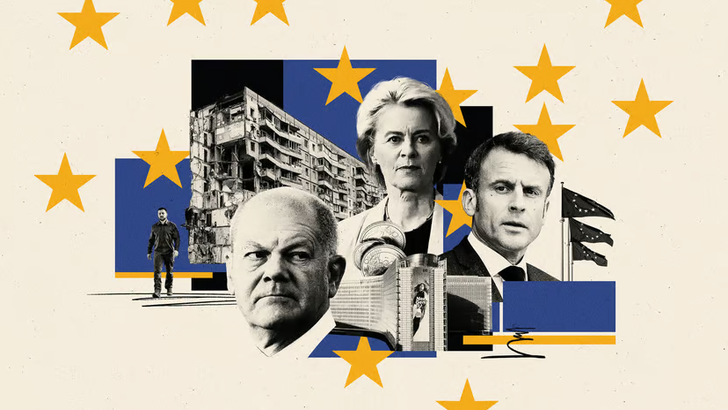
For a moment last year, it looked as if Ursula von der Leyen's bid for a second term as president of the European Commission would not be certain.
On an unscheduled trip to Israel in October, alongside Benjamin Netanyahu, she expressed unreserved solidarity in the country's battle against Hamas.
Her statement would not be considered inappropriate if, for example, the president of the USA said it. But speaking out as head of one of the European Union's most powerful institutions on one of the bloc's most divisive issues, she caused the biggest backlash in her four years in office.
Angry diplomats had ignored a joint statement by EU foreign ministers representing the bloc's position and calling for restraint and respect for international law by Israel. About 800 employees of the Commission signed a letter criticizing its "unconditional", "uncontrolled" support "for one of the two sides" in the conflict. Von der Leyen's top diplomat, Josep Borell, publicly reprimanded her for speaking for the entire EU.
"She's acting more and more like a queen," one EU diplomat told POLITICO at the time, criticizing her for going beyond her job description, removing EU governments from its own decision-making and governing with a small group of advisers.
However, for several months, von der Leyen's position is strong again. Without apologizing or looking back, she has weathered the political storm and emerged, if not stronger than ever, at least unscathed. Not only does she remain the main candidate for a second term as president of the Commission; No other candidate appears to stand a chance of displacing him when EU leaders meet this summer to hash out the bloc's top positions.
In November, von der Leyen refused to confirm he would run again, but cheerfully answered a question about what he would do with a second term, saying he would "keep his eye on the big issues" namely the Green Deal. , digital transition and resilience.
In conversations with dozens of EU officials and diplomats, few expressed serious doubts about whether she would enjoy a second term if she wanted one.
Criticism in Brussels has again been quieted, or at least retreated behind closed doors, as officials do not want to risk moving to the "13th floor" of the Commission's Berlaymont headquarters, where von der Leyen and her team have their offices. .
As she answered questions from POLITICO, she had a twinkle in her eye that no one can stop. But while an undisputed re-crown remains the most likely outcome so far, there is still a chance the race could throw up surprises.
Homecoming Queen
Von der Leyen arrived in Brussels almost unexpectedly. When her name surfaced in 2019, she was a mystery outside of Berlin, where she had climbed the ranks of German politics under then-Chancellor Angela Merkel.
For the then German defense minister, however, this appointment was a 'homecoming'.
Her father Ernst Albrecht was one of the first civil servants of the EU. He spent the first 13 years of his life in the Ixelles neighborhood of Brussels, under the shadow of EU institutions, attending the European school.
It was also a chance to jump from a sinking ship. Initially seen as Merkel's protégé, her career sank after a scandal over her ministry's use of outside consultants without proper oversight. Even as von der Leyen moved into one of the EU's top offices, she was facing a parliamentary inquiry
However, it wasn't long before the criticism was disappearing. Von der Leyen quickly raised her profile in Brussels, emerging as the most powerful Commission president since Jacques Delors, the titan of European politics who died in December.
She almost sleeps in the Commission headquarters. She works long hours, including weekends. Her grueling work and travel schedule has become a running joke in the EU neighborhood, especially among aides.
Her performance under pressure stamped her as a successful crisis manager: dynamic, well-prepared, very close to Washington, able to cut through the fog that sometimes envelops Brussels. As her mettle was tested first by the COVID-19 pandemic and then by the war in Ukraine, she became in capitals across Europe the public face of a sometimes distant European bureaucratic machine.
French and German leaders are seen as arrogant and boring. Her institutional rival, European Council President Charles Michel, is seen in Brussels as distracted and prone to blunders, particularly after the "Sofagate" scandal in which his apparent attempt to upstage von der Leyen during a visit in Turkey it left him looking sexist, inconsiderate and incompetent.
It was "almost House of Cards style," said Theresa Kuhn, a professor of European studies at the University of Amsterdam. "She used that opportunity to push herself forward while he saw himself completely trapped."
Michel announced on Saturday that he will stand as a candidate in June's European parliamentary elections, meaning he will almost certainly give up his current position in July.
What's the problem?
The problem for von der Leyen is that her strength is turning out to be one of her biggest weaknesses.
In navigating its crises, it sometimes bypasses commissioners or snatches decisions out of the hands of national governments accustomed to ruling the 'world' in Brussels. After Russia's full-scale invasion of Ukraine, for example, the Commission kept discussions about sanctions under wraps, coordinating with Paris, Berlin and Rome, but also Washington, and presenting the package only at the last moment when member states were ready to consider it.
"The EU has always been criticized as slow," Kuhn said. "It sometimes grabs a bit of power in some decisions, but on the other hand it's the most effective way of doing things"
This may be true. But her monarchical approach and centralizing instincts have also shaken the foundations in Brussels – and not just in the perennially battered European Parliament, where lawmakers have always pushed ineffectively for more democratic oversight.
Several senior Commission officials told POLITICO that the style of von der Leyen and her team is causing complaints at all levels of the EU executive. "It's driving us all crazy," said one European Commission official who, like the others, asked to remain anonymous when discussing their boss. "If she stays for another term, there will be a clear signal from within the building that things will have to change"
More worrying for von der Leyen is the fact that the irritation is also growing in European capitals, without which she cannot secure a second term.
EU diplomats often try to play off von der Leyen's announcements, from sanctions to China policy, relations with the United Kingdom and, more recently, her stance on Israel. "It does its work without formally consulting member states," said an EU official.
The Commission has been in a long confrontation with Hungarian Prime Minister Viktor Orbán, who has not hesitated to voice this criticism. "How often does it seem to the public that Europe is being run by just one man," Orbán said recently. "She talks as if she is the leader of Europe - when in fact she is our employee, our paid employee, whose job it is to carry out what we decide"
Orbán, who alone would not have the power to block her appointment, may be the only leader to make public statements of this nature. But as is often the case in Brussels, it is impossible to know how many others are hiding behind it.
According to some French officials, French President Emmanuel Macron is irritated by von der Leyen's repeated displays of independence. Her initiatives on the Israel-Hamas war were seen in Paris as a "personal PR effort" "before the campaign", a French diplomat said.
"She thinks she has no boss," the diplomat said. "If we cannot control her, she must be controlled... We sent her a clear message that we are the ones who give her the mandate"
To take office, von der Leyen must be nominated by European leaders and confirmed by the European Parliament.
In 2019, she was put into office with the support of self-described pro-EU EU parties: the conservative European People's Party, the Socialists and the liberal group Reneë.
That gave her a narrow majority: 383 votes, just above the minimum of 374. With the far right on the rise across Europe, von der Leyen may struggle to repeat that victory. "There could be a real surprise," said a French member of the European Parliament from one of the pro-European parties.
If the coalition fails this time, "there will be no majority", said the lawmaker. "And the subject of von der Leyen will simply no longer exist. If we don't find a majority, it will be ungovernable."
Similar comments have started to come from European diplomats: "She is the leader, without a doubt, but with these polls... it is too early to say if she will surely be elected again", said a diplomat from Central Europe.
"This time finding a majority may be really difficult and the majority may be really weak," another diplomat said. "How this will affect her re-election is unclear to me. What is clear is that against this background, it is very difficult to provide strong guarantees."
Judicial challenges
A court is expected to rule in early 2024 on a lawsuit brought by the New York Times against the European Commission for failing to provide access to text messages exchanged between von der Leyen and Albert Bourla, CEO of pharmaceutical giant Pfizer.
The dispute dates back to 2021, when, according to a New York Times report, von der Leyen and Albert Bourla personally negotiated a vaccine deal in which Pfizer agreed to provide EU countries with 900 million doses, or enough to inoculate the block three times, with the option to buy back that amount.
The EU had already made two deals with Pfizer and BioNTech, another vaccine company. But this deal was unprecedented in its size. Previous agreements had gone through a complicated negotiation process involving a board of representatives from all 27 EU countries, as well as selected negotiators.
The commission has denied journalists freedom of information requests for the text messages, arguing that if they exist, it cannot find them. A variety of watchdog agencies have also tried to shed light on the issue – without success. A special parliamentary committee investigating the pandemic, which tried to get the president of the committee to appear before a panel to answer questions, did not get more clarity.
The scandal has not resonated beyond journalists in Brussels and anti-vaccine skeptics.
"We are talking about billions of profits that these vaccine manufacturers made," said Belgian MEP Kathleen Van Brempt, who chaired the special committee.
The deputy said that she did not believe that the President of the Commission was personally corrupt, but the ambiguity undermined democratic supervision: "I am not against profit, but things must be transparent, clear and done according to the rules. And they weren't."
Von der Leyen herself has refused to address the issue – even when the cameras are pointed directly at her. So far, this has proven to be a winning strategy…
If von der Leyen is worried about all this, she isn't showing it – nor is she likely, whatever news may emerge, to allow herself to be seen sweating.
Whatever happens, whatever the decisions, whatever the results of the various investigations, the most likely scenario remains the same: von der Leyen calmly smiling her way to a second term./ Politico.eu