"Condemned" protesters?! Who trapped Rama inside the Prime Minis...
/ 2026-10-23 16:02:00Focus


The agreement between Italy and Albania for the housing of immigrants has received many reactions. Many foreign media have dedicated articles on this cooperation between the two countries.
In an article of " The Telegraph " it is written about the two places where immigrants are expected to be sheltered in Albania, Gjadra and Shengjini. It is also mentioned how the way of life there will not be the same after the arrival of the refugees.
In the writing of the British media, the statements and opinions of the residents in the two northern areas are brought, where some of them express themselves against this decision and some say that there is nothing wrong.
FULL WRITING:
It's a picture of bucolic tranquility: an old woman in a white headscarf herds a few cows along a muddy country lane, a young man cuts fodder with a scythe, and farmers drive past in small tractors.
But the gentle pace of life in Gjadër, a village in northern rural Albania, is about to be shattered after it was announced this week that Italy had been given permission by the Albanian government to build a large migrant detention facility on its outskirts.
Many residents of this dark part of the Balkans are shocked by the idea that the holding center will house up to 3,000 migrants each month, with 36,000 expected to pass through each year as their asylum claims are assessed by Italian officials.
"People here are not used to seeing foreigners. They are not happy", said Niko Rroku, 43 years old. "It feels like when the British sent their convicts to Australia. Some people here are scared for their lives. You don't know who these immigrants are. There may be terrorists among them." He speaks almost flawless English, having moved to the UK as a teenager and found work as a builder in St Albans.
Albania may be a country of emigration, with a large diaspora around the world, but many people are deeply concerned about the construction of the migrant center - and especially that it will house only men. The Italian government has said that women, children and especially vulnerable migrants will not be sent to the facility.
"I am worried that I will have to start guarding my house"
"If only single men come here, it will be a problem. I'm worried I'll have to start guarding my house in case they try to break in," said Armondo Hamolli, 30, a hairdresser who runs the village's barber shop.
The facility is likely to be built on two disused airstrips adjacent to the village, relics of a military base from the communist era. One of the airstrips is guarded by a haggard-looking soldier whose AK47 assault rifle is slung over his shoulder on a tattered canvas strap. Nearby, goats graze under the shade of pomegranate bushes.
The deal, which has drawn comparisons with the Sunak government's troubled plan to send migrants to Rwanda, was announced this week by Giorgia Meloni, the Italian prime minister, and her Albanian counterpart, Edi Rama.
Migrants caught in the Mediterranean while trying to cross from North Africa to Italy will be sent by the Italian navy and coast guard to the port of Shengjin in northern Albania, where the Italians will build a reception center.
From there, the male migrants will be taken by road about 15 miles to the holding facility in Gjadër. Those whose asylum applications are accepted will be returned to Italy. Those rejected will be repatriated to their countries of origin. The Meloni government insists it will process the immigrants quickly and none of them will stay in the center for more than 28 days. The plan will cost Italy about 16 million euros per year.
"The initiative has been met with a storm of criticism"
That's the theory, at least. The initiative has been met with a storm of criticism on both sides of the Adriatic, with opposition politicians in Italy and Albania saying it is fraught with legal, ethical and practical difficulties.
If women and children will not be accommodated in the facility, does this mean that families will be separated? What happens to failed asylum seekers whose countries of origin refuse to take them in? The immigrant center will be built and operated by the Italians, but what are Albania's legalities for granting extraterritoriality to a foreign power?
Critics in Italy are calling the planned facility "a Balkan Guantanamo" - a comparison that Foreign Minister Antonio Tajani has disputed, insisting the deal respects EU and international law.
So far this year, more than 145,000 migrants have reached Italy, of whom fewer than 4,000 have been repatriated. Italy will not only have to build migrant facilities in Albania, but will also have to provide police, lawyers, translators and medical personnel.
"We must achieve in Albania what we have not achieved in Italy for years"
"Do we really think that we will be able to complete the identification and asylum application procedures for every migrant in 28 days when in Italy it takes months?" said Emma Bonino, a former foreign minister and European commissioner. "We have to achieve in Albania what we have not been able to achieve for years here in Italy. And if there are delays in their applications [the center] will be overcrowded.”
"Immigrants who have the right to protection will be brought to Italy. And those who are not eligible but cannot be repatriated to their country of origin? They will also be brought to Italy. So Albania will just be a post on their journey," Ms. Bonino told La Stampa.
Marco Minniti, a former Italian interior minister, said there was an irony in the fact that the British want to send their migrants, including Albanians, to Rwanda, while Italy wants to send its migrants to Albania.
The migrant center will operate for five years, with the option of a further five-year extension. Ms Meloni has promised it will be up and running by spring, but when The Telegraph visited the site this week there was no sign of construction. One of the runways is filled with large concrete blocks, while the other is used by the villagers partly as a road and partly as a garbage dump.
It is not just the villagers of Gjader who are alarmed by the prospect of having the migrant center on their doorstep. Down the coast, residents of Shengjin worry that the image of immigrants landing at the port will damage tourism.
Shengjin is an extremely popular holiday resort - a phalanx of hotels line a long arc of sand on a shimmering blue bay.
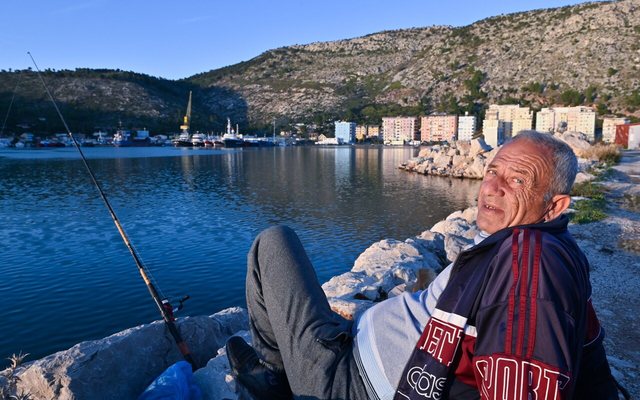
"I think it's a crazy idea," said Armand, 29, a plasterer who was fishing at the end of a cruise with his father. "I think it can damage the country's image. Many Brits are buying apartments here. It's cheaper than Greece, the food is better and the views are amazing.”
Authorities in the nearby city of Lezha said they had no idea about the project until they heard about it on television on Monday, hours after it was announced in Rome.
"It depends on how the immigrant center is managed," said Ermal Pacaj, the city's center-left deputy mayor. "If it goes according to plan with Italy and there is good security, there will be no impact. This will be a way for Albania to reward Italy for welcoming and integrating our people as immigrants over the past 30 years. But if things go wrong, we will have problems."
Sali Berisha, a former Albanian prime minister and president who now leads the center-right opposition, is a fierce critic of the deal.
"I fear it will greatly increase xenophobia in a country that is normally very welcoming. We cannot support this burden. Migrant centers have caused many problems in countries from Greece and Italy to Spain and Northern Europe. And there is a characteristic of Albania that makes the whole thing more explosive.
"People brought here from Italy can become victims of trafficking"
There are many illegal people being trafficked here. People who have been brought here from Italy can become victims of trafficking," he told Italian media.
He accused Edi Rama, the prime minister, of drafting the agreement with Italy "in secret, without a mandate" and said that it should be referred to the parliament and the Constitutional Court of Albania.
In the village of Gjadër, not everyone is alarmed by the prospect of the repatriation center.
Many Albanian families have experience of emigrating in search of a better life and sympathize with Sub-Saharan Africans, Bangladeshis, Tunisians and others trying to reach Europe by boat from North Africa.
"For me there is nothing wrong with the plan. The immigrants will not stay here, they will just pass through," said Nikolle Voci, a man in his sixties who lived for a while in Australia. "Other countries have helped Albanians in the past. Now it's our turn to help.”