"Condemned" protesters?! Who trapped Rama inside the Prime Minis...
/ 2026-10-23 16:02:00Focus


For more than 20 years, Lazam Kaci from the village of Borie-Lure in the northeast of the country, has not lowered his vigilance for a single moment. The 83-year-old man, whose house and farm are located under the amazing forests of Lura, has defended with strength and diplomacy the high and very valuable trees that nature has given him. He is known by everyone in the area as the "silent hero of the forests". Lura, declared a National Park since 1966, is today one of the most deforested areas in Albania. Everywhere you look, you can see stumps of trees. Apart from the forest protected by Lazami .
"From the beginning, when this situation continued, I was against it. I was against it, also for my own interests, because if the forests were cut, avalanches would cover us, but I was against it for the public interests, and for the interests of Lura's own nature that was a beautiful place, it was a favorite, it was well-known. But here no one asked about selection, except: Beggar! Beggar of this wealth that you have in your hand. Everything about wealth has been destroyed. Everything that makes you rich has been destroyed group. In the dacha, they called oligarchs, in the dacha, they called the supporters of the rulers. They were given a free hand."

With pride that he cannot hide, he says that he defended the forest with force, together with his sons. But at the same time, since the environmental massacres started in 1997, he has not stopped sending requests to the prime ministers, presidents, and environment ministers of the time. "I predicted this situation that resembles a massive explosive charge, which with an external stimulus will cause a massive catastrophe and so it happened" - he wrote in a letter addressed to the president, 20 years ago.
Deforestation of Lura
Since the 90s, the dense forests became the "prey" of many who saw the wood as their own property with which they could do whatever they wanted. "Mirdita and Mati took the wood from us. Here the residents have partially done damage. I cannot exclude anyone. I say with complete conviction that in that period, everyone, even those who were in working relationship with the state, with the government, they also did the damage, their part. So you can't single someone out. However, the forestry enterprise was not efficient. Managers and employees at that time called it a privatization, how to have their property and it was unlimited permission" - says Leonard Rajta, head of the Lure Administrative Unit, emphasizing that the biggest damages belong to the past.
Off camera, the residents themselves say that there were many villagers in the area who, when they moved to Tirana for a better life, around the year 2000, used forest wood to build new houses. However, they do not take the responsibility of being the main culprits of deforestation.
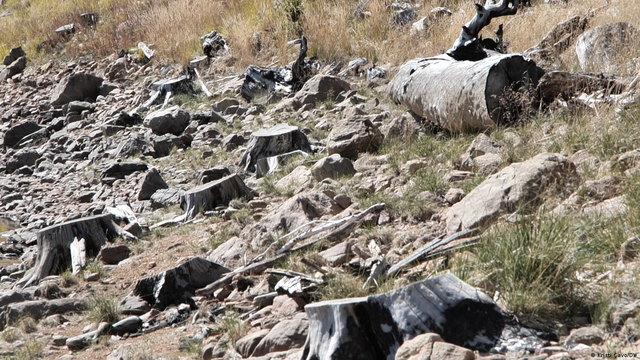
"These deforestations are not done for survival. They are not done for the people, by two people who are left without bread, no. In fact, where business intervenes, forests are destroyed, ecosystems are destroyed, nature is destroyed and everything. I repeat this without shame: To our ancestors have been cutting down forests all their lives and the forests have not disappeared. Why? Because they came carefully, with that chief, with that forest technician, and cut the two trees, three trees that you needed and left it to grow. But now, one goes there for business at night, forests are cut everywhere" - emphasizes Hajri Haska, forest expert and lecturer.
The same thesis is defended by Lindita Çela, journalist of the Investigative Network Against Organized Crime and Corruption, OCCRP. "If we look at all the links, starting from the commercial companies, from the tender procedures, from their licensing, from the work they do, what percentage of the territory have they revitalized with new seedlings and what percentage is under fire, I think the analysis will work out for us. That we are not even dealing with local cases, we are no longer dealing with sporadic cases. We are dealing with an organized network, which has not only found the way to get the project and to win the tenders, but also to lose track".
The European furniture market, the final destination?
Among the most valuable species found in Lura are the white and black hemlock, the cypress, as well as the black pine, trees that grow up to 1700 meters above sea level. According to the "National Inventory of Forests and Pastures in Albania", published a year ago, "the forest area affected by illegal logging over the years amounts to 8%, or 96,067 hectares". Experts say that the figures of losses are several times greater, although everyone wants to stay away from the "numbers trap".
"White ash wood is a soft wood that is easily worked by wood craftsmen, especially in Lure, it has been used since ancient times. Around the year 2000, its value increased a lot, that at first it was sold for 20 thousand old lek. And later it went for 100 thousand old lek per cubic meter, body, not board. The board used to cost 600-700 thousand" - says Agim Leka, forest engineer in Lure.
In 2016, the 10-year forest moratorium was approved, which in theory prevents any industrial, commercial, productive and economic activity in state and private forests. But practice shows the opposite. In the seventh year of the moratorium, official figures show that timber exports have increased significantly. According to the Institute of Statistics, from 2016 to the end of 2022, the value of exports of wood and its articles has increased by 44.6%.
According to research by EuroNatur, an international environmental association that also conducts research in Albanian forests, the final destination of the wood is not known for sure. "It's not easy to prove because there's no good tracking system for the wood. It's quite easy to get it into the legal market, even when the wood comes from illegal sources or the black market. And those who bring the illegal timber to market they are not interested in leaving a trace. What we do know is that Central Europe is an important market, but we also have reports that timber from Europe is being exported to China or Japan as well as the United States. But we also have transport in the other direction, that is, wood from the USA or North America that comes to Europe. It is quite a complicated market. And if you want to know if, for example, the wood of Šebenik-Jablanica has finished pallets in German supermarkets, then you have to apply scientific method. Of course it can be subjected to this analysis but it is very voluminous and very expensive work to try" - says Gabriel Schwaderer, Executive Director.

On paper, Albanian law provides up to one year imprisonment for illegal logging. However, no one ever ends up in a cell. Since the entry into force of the moratorium, the prosecutor's office registers 1058 proceedings for illegal cutting of forests, but in the end the courts suspend the prison sentence decisions and the defendants are released, only with probation. More specifically, last year, in 90.7% of cases, the court suspended the prison sentence decision and the defendants were put on probation. In one case the case was dismissed and in five other cases acquittal was granted. The highest number of proceedings for criminal offenses was registered in Korçë, Elbasan, Lezhë, Shkodër, Dibër, Kurbin.
Revitalization, mission (impossible).
"The cost to rehabilitate Lura, to bring it to the same state as it was, is very high. And I think that the municipalities that may be included in that territory, as well as the administration of the protected area or the National Agency of Protected Areas, it is impossible to financially cope with this rapid rehabilitation. On the other hand, we must say that the budget of the Ministry of Tourism and Environment or even the National Agency of Protected Areas is very limited, which shows that even the number of the respective staff that must supervise and administer these territories is very small compared to the surface" - says Klodiana Marika, Director for Nature and Forests, in the Ministry of Tourism and Environment.
Even though a lot of damage has been done there, says professor Hajri Haska, the situation looks promising, but again, great care must be taken. "The Lura has started to regenerate in some places. Even the specific species that are there for example the arneni, the cypress they say, or even the spruce and the beech, have started to regenerate quite well and in a very satisfactory condition. It's just that now it takes a lot be careful. Because the sprouts, in the first beginnings, want a little shade. Because there are two moments, either a very difficult heat in the first year can burn it, or a very strong winter. Therefore, cattle categorically should not be grazed in the moments when there is renewal".
But as if the chainsaws were not enough, the fires, in most cases intentional, have been another shock wave for Lura. They started in 2007, when Lura experienced one of the most damaging fires ever. "To shut down the corruption, to shut down the trafficking so that they don't come out, they came and set fire to it. That day, in the morning I went out with the sheep, I was going out with the cattle then, and I was going to the other side and I saw that they were coming people to set fires everywhere. But not only here, but also in areas outside Lura, it was the same date, on the same day," says Lazam Kaci.
*This research was carried out by journalists Elona Elezi and Esmeralda Cenollari-Topi, with the support of Journalismfund Europe.