Is this police force professional and capable of handling violen...
/ 2026-10-16 18:54:07Focus



In these 30 years of transition, the country's investments in human capital show deterioration, as Albania has the largest flows of young people leaving the country.
Emigration, which has become the "profession" of the future for the majority of young Albanians, is further deteriorating human capital.
Education, which is the largest sector where human capital is invested, is deteriorating on several indicators instead of moving forward.
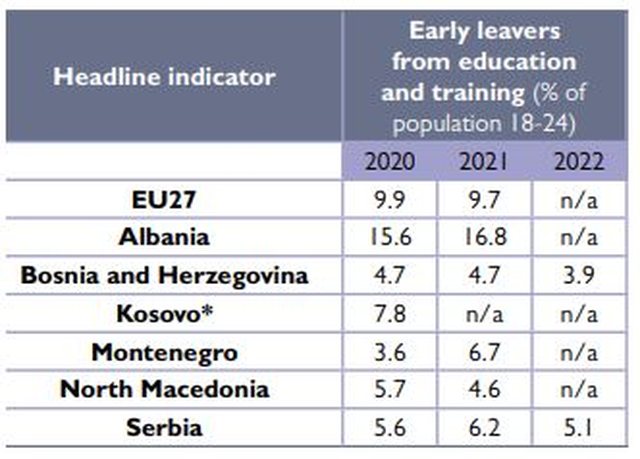
A recent study by the Regional Cooperation Council points out that Albania has the highest percentage of early school leavers in the Region.
Comparative data shows that in 2021 nearly 17 percent of the population aged 18-24 were neither in education nor training. This high percentage of 20-year-olds without any commitment to education was almost three times higher than the European average. In Bosnia only 4.7% of young people aged 18-24 were neither in education nor in training, in Montenegro 6.7%, in North Macedonia 4.6% and in Serbia 6.2%.
The number of early school leavers has fallen in most Western Balkan economies in 2021 and mostly remains below the EU average (9.7% in 2021), except in Albania where the phenomenon remains high and increasing compared to 2020 .
Although all Balkan countries continue efforts to improve education programs at upper secondary and higher levels, adult participation in education and training remains low across the region.
In Serbia, 4.8% of the population aged 24-65 participated in training in 2021, which is the highest participation rate in the region, despite still lagging behind the EU (10.8%), while in other countries is too low.
The lack of opportunities for adult education and lifelong learning affects employment and therefore better employment opportunities in the adult population.
The lack of continuous learning hinders sustainable economic growth and the adoption of new development models, technology diffusion and economic development while taking care of the environment.
The share of young people neither in employment, training or education (NEET) decreased slightly in 2021 in almost all Western Balkan economies, but in Kosovo this category includes 40.4% of young people, 26.5% in Montenegro, 26.1% in Albania, 25.1% in Bosnia and Herzegovina, 24.2% in North Macedonia and 18.8% in Serbia.
In the EU, only 13% of young people aged 15-29 are neither at work, nor in school, nor in any training.