Is this police force professional and capable of handling violen...
/ 2026-10-16 18:54:07Focus


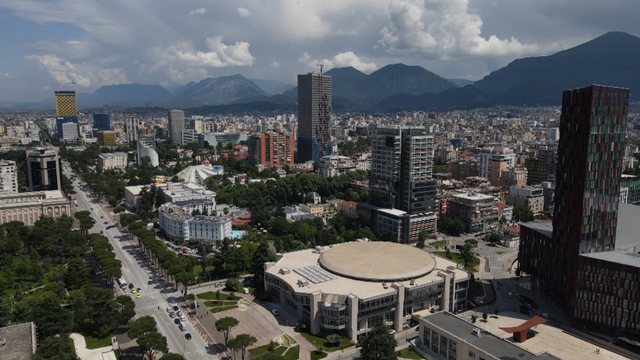
If we were to look at Tirana as tourists, or simply observing it from above, we would likely perceive it as that typical developing city.
The straight line of the central boulevard, elevated by towers and full of projects that promise modernity. A panorama of development that seems to convince you that this city is extremely livable.
But the city is not understood from the sky. It is not understood as a visitor. It is read on the ground, by those who live it every day, in the streets that have narrowed, the spaces that have disappeared, the old buildings that are no more, and in the histories that have been erased to make way for another vision.
The documentary "Vertical Tirana: The Architecture of Power" by Citizens Channel is not just a story about towers. It is a visual testimony to the way power changed the capital, and through it, reality.
The change first emerged as a vision through the General Local Plan “Tirana 2030,” which promised a balanced city: with public spaces, green belts, organized transportation, and controlled development. A break from the chaos of the past under the ruleless transition.
But real development followed a different trajectory. Instead of a planned city, a “negotiated” city materialized. A space where the plan was constantly violated, rules were bypassed, and development was channeled toward a single model: verticality.
In a decade, over 140 tower projects were considered or approved. Millions of square meters of construction have definitively changed the profile of the capital, causing a deep confusion to prevail: for whom was this city built?
"Towers are not 13-14-15 story buildings, towers are buildings that are over 20 stories high and in fact there are few of them. First of all, these towers have given a completely different energy to the city."
– Edi Rama (Prime Minister of Albania 2013-2029)
"My promise is that we will have a moratorium on construction with the government, to stop construction as the government has decided and to make sure that we first save all public spaces for parks... and I do not intend to go down in history as someone who gave [permits for] buildings, I want to be remembered as someone who worked to return the city to normality and as someone who will be remembered with a team that built more parks than buildings."
– Erion Veliaj (Mayor of Tirana 2015-2027):
“Who is 'pro'?”
– Aldrin Dalipi (Chairman of the Municipal Council, December 2017).
"The majority votes in the City Council gave the green light to the capital's master plan..."
Tirana 2030 was written according to the concept of the Italian architect Stefano Boeri. A city with 6 new urban centers supported by five rings, two for public transport, one green ring, one blue. All around a natural border: the Orbital Forest of 2 million trees, conceived as the new lungs of the city.
The plan promised a break from the past. A city that develops fairly, guided by planning, not by the pressure of construction.
For the first time, Tirana's future was secure...
"The ambition is for our 2030 capital to be the city with the largest pedestrian space among the capitals of Eastern Europe."
– Rama
"Until today, urban plans have rightly been seen as development plans, or plans for building permits, construction spots and intensities, and of course bargaining between politics, the municipality and builders, but of course this has nothing to do with the document we have today..."
– Veliaj
In the years that followed, the plan began to take shape.
Tirana 2030 was changed, violated and desecrated by its own drafters. In a decade, construction gained unprecedented momentum. Millions of square meters of construction, 140 tower projects, from 20 to 100 floors, approved by the National Council of Territory, an organism with supra-legal power, which violated every criterion and limit set in the urban plan.
"There are two ways you can erase history, one is by erasing it, that is, by erasing any trace of it, and people automatically pass by it every day and forget that there was an object there. And the second is by completely transforming it, stripping it of its identifying, characteristic features, and over the course of generations, it returns as a "former" place, initially and then reactivated with a new name and identity."
– Doriana Musai (Architect/Urbanist)
Today, no policy of this government can be understood without architecture. So every project has architecture, there is no longer administrative communication of economic budgets, but everything is related to architecture. The problem we have is that the entire economy has been introduced, all the public and private investment money has been introduced and now supplies this architecture, which has exploded to fantasy levels, to schizophrenic levels to justify, I am saying, the channeling of budgets, which normally would not be justified.
– Ervin Goci (Communication Pedagogue/Activist)
Today it is claimed that it is a democratic space. In fact, it is more a space of political combination plus the builder, it is more an oligarchic space. Here the relationship of the architect or the urban planner is greatly minimized, why? Because it is the desire of power, it is plus the desire of the builder and the need, when we say desire we include the desire to get rich and the desire to dominate and then in this ensemble, in this architectural paradise that is called Albania, especially Tirana, the architect is invited to express his own desire, who tries to read the desire mainly of himself plus that of the one who gives the building permits, so in a combination of desires, that is why this kind of architectural panorama emerges.
– Nebi Bardhoshi (Prof.Dr./Anthropologist)
From above, the boulevard looks monumental, a straight line that runs through the history of the Albanian capital. But the city is not read from the sky, it is understood and lived on the ground, in the footsteps of the man who walks through it.
To understand, we must walk where the government has left its mark, in the first segment in just five years, three buildings that represented 100 years of urban history were demolished, alienated, or privatized.
The Boulevard of the Martyrs of the Nation is also the main axis of the city, the one that gave life to the capital, that is, it transformed Tirana from a suburban city, or town as it was before the establishment of the Albanian state, giving it the formation of a capital, of a city, which could expand and create those strong points of the new Albanian state.
If we wanted to take an X-ray of the Albanian state, we could take the entire Boulevard of the Martyrs of the Nation and every intervention that has been made on it, in fact it is a trace of all political systems, all major social events that have occurred, so it is a historiography of the entire development of the Albanian capital and the Albanian state as a whole in so little, in 1 kilometer of road.
The stadium was a Category II Cultural Monument, it was within a protected area, it took a government decision in 2017 to remove it from the protected area to make its demolition possible.
So the city took the form of the Casamonti stadium of Air Albania or of the construction company that brought it, rather than the opposite, the stadium adapting to Tirana and this ensemble. We can no longer say that this object is a public object, this is a completely private object, which is managed time and again with the permission of the private by the public.
We often say that we have a tower with a stadium inside, or a shopping mall with a tower with a stadium inside, and practically the way it has been since its opening and until today, we have had fewer matches than cafes.
– D. Musa
From the stadium, a symbol of Public Private Partnership, the boulevard continues towards another transformed monument with a similar model, but different actors.
The pyramid, once the dictator's museum, was not demolished. It was stripped of its meaning and repackaged as a space for young people. The project was entrusted to the Dutch studio MVRDV and cost around 18 million euros.
Today, surrounded by colorful cubes housing cafes and businesses, it stands as a missed chance to reflect on the past.
It is representative of the transition, indeed everything we did wrong is incorporated into the Pyramid and will live on, as a... I think, so it comes from the dictatorship and it is the model that we... not only did we not know the dictatorship, nor understand it, nor interpret it and then heal our wounds, but we hid them, polished them and made a Frankenstein object with which we don't know what to do with it now.
When in 2018-19 the Pyramid began to be discussed again, all other actors of society were excluded, under the guise of an American-Albanian foundation [AADF] every action was justified and even though in fact the object itself was saved precisely because of the citizen reaction, the citizens were not included at all, they were excluded. So the Pyramid personifies both a kind of stubbornness and a kind of authoritarianism, of course because it is the object of the dictator, but also of a kind of arrogant behavior of those who are in power today, a kind of continuity and a kind of behavior of the government towards the city where a kind of narrative is imposed, which of course may seem beautiful at the level of propaganda, but which the city must digest and accept and of course what is superfluous can and will reject.
This building can be passed from the outside, while from the inside, the model that AADF brought is actually a public-private model, so it was never meant to be public, other than the narrative being told as if we were doing this in the public interest.
– D. Musa
If the Pyramid was reformatted, the National Theater was brutally erased. The old theater had to disappear, to make way for the new one. The beneficiary: A private firm that exchanged the new theater for public land for towers.
For almost two years, citizens defended it, until on May 17, 2020, at dawn, the building collapsed.
That night not only brought down the theater but changed the relationship between the city and the government. The citizens were betrayed, the theater was violently demolished, the contract with the private company was withdrawn. Today, the theater is being built with the citizens' money. The government found another way to sell public land for the towers that have begun to rise.
The King bought the Libohova family [1938], 10 thousand square meters of land to build a theater and for many, many years, 10 thousand m2 were owned by the theater and the Albanian state until the protests began and we discovered that some of the square meters had been sold to private individuals through unauthorized construction that had been legalized at the expense of the theater, one of whom then, 247 square meters of land if I'm not mistaken, claimed to receive 10 thousand m2 of land through a special law, which would give him the opportunity to build the towers and in return would give us a theater in the city.
This, unlike the stadium, unlike the Pyramid, but almost identical to them, brings a kind of imposed relationship when the state attracts the private sector as an interlocutor, excluding the public, practically imposing on us a kind of contractual relationship where the one who benefited alone, who benefited the most, was always an individual at the expense, this time a public property inherited for 80 years, in a public building with a completely public function and in exchange it will give us a 34-story tower with a theater that we do not know how it will end, who will manage it, how public it will be and how private it will be, with half the area of what we had, with half the capacity of what we had, we are dealing with half the land of the theater, it is no longer in use by the theater, it will be a square and has turned into the square of the tower of "Fusha shpk" that is being built from behind, even though on paper it may continue to remain the property of the municipality [Tirana] now that we have a municipal theater, we no longer have a National Theater.
– D. Musa
Theater was a breaking point. But what followed was the discovery of the true model, the disappearance of memory, and the rise to verticality as the new language of power.
The biggest problem is that today we have certified that Tirana must be fertile land of towers, it cannot be anything else. Is there anyone today who can say that Tirana can be anything else?! It is very difficult… we do not hear from the opposition, there are other subjects that are whispering, of course, there is a reaction, but no one calls the model into question.
– E. Goci
Skanderbeg Square is the space where this model is most clearly manifested. A history of projects that were returned several times, reflecting the stubbornness of the rotation of power. In the end, an urban operation that cost over 30 million euros and was entrusted to the Belgian studio "51N4E".
At first it was conceived as a pedestrian space, but tower projects began to rise around it, first one, then two, four, seven; while others await the formalization of permits.
Today, the square is an open courtyard where verticality is exhibited, a playful balcony for the towers that surround it.
For me, the discussion of the center of Tirana is of a peripheral nature, because we see it only as a separate space, while in fact an optical illusion has been created in that square, which has sought to legitimize, even visually, the construction of large towers, so you enter there and from there it seems like there is space, in fact that space, of course, is limited, and in the meantime towers are being built, because everywhere it simply seems like the tower has some perspective, but in fact the tower is very close.
The space of the square creates this, for me the square has really been used as a center, as a "trick" like a game of prestige, which seeks to focus all the attention of citizens and tourists on one point, taking the attention away from the tower, and the tower, if you see it from the square, seems a little far away, it doesn't seem very close, it creates a kind of breathing space, but meanwhile if you move away from the square, everything is then suffocated.
If you look carefully, the National Museum project is quite transformative and there is talk that there may be a construction in the middle, although it is not yet very clear, at the Opera it is said that there will be a collapse, there will be an opening and there will be a radical transformation. So those that were “landmarks,” that were points of reference of the square and Tirana, they are no longer as we thought and imagined them, but are in a precarious situation that from moment to moment awaits change. These ministry buildings very quickly… have lost that kind of authenticity and uniqueness because towers have been built next to them. Look at the [Tirana] Clock how it has been squeezed between two buildings that are totally unrelated to it. The clock today may be a souvenir that you keep in your little pocket, but it no longer has any connection as a symbol of the city, it no longer has any kind of value.
I am absolutely convinced that Skanderbeg Square is simply the free space, I'm not saying public, of the towers. The carpet of exposure of these [towers], and if you look carefully at the square, everything stands and everything is exposed except for people.
And by the way, this [transformative] thing is not over because the towers are not finished. The towers continue and are signed for days, we have towers here at the former UFO in the “Piazza”, we have towers behind the Opera, one that is being built and another that is still planned to be built and what else we don't know, and you see that here it is now surrounded, a wall has been built here, a fence with towers has been built and the entire space of the square is a kind of flowerbed without flowers and towers.
– E. Goci
Beyond the historic center, the model extends. It is not content with transforming and replacing the old, but requires territory.
The New Boulevard was presented as a natural extension of the city. But in fact, it is the space where the city is not corrected, but rather reproduces its own model.
If we have a question about what political regime we are, we take a walk on the boulevard and realize that... it shows a lot, whoever reads the architecture shows a lot about how we have... what current regime, what is materializing, from the beginning to the meeting point where the boulevard ends tentatively, "New Boulevard".
The government has constantly produced uncertainty regarding ownership. Especially after 90, they are not even sure, many former owners have not received their legal property and the entire dynamics within Tirana are known and of course the most expensive area is the boulevard and the tension has been greater due to the value and pressure for construction. While here there is a second characteristic here, people here are people who came after the 90s, everyone is presented in public as occupiers, at least today this image has been instrumentalized a lot, because in the first place the panorama has not been given that there are many people here who came and bought the land at the end of 88-89, they came and bought, they were part of farms or state enterprises when they received these parts, so the social situation is much more plural than it has been presented, the other or the newcomer specifically has been stigmatized.
With "May 5" it has been proven and is our main evidence because we should not have passed it so quickly, but unfortunately the city of Tirana does not have strong communities that speak out on these issues, as well as on many other issues, but this issue has been very fundamental for a single reason because the legalized ones have been treated again as people who have received undeserved property and consequently the state was given the right to destroy it, or to take the property away whenever the state was interested. This was not the legal solution and the main tension even when the ring road was built then and continues today is that everyone refers to the "May 5" case as a possibility that by tomorrow the state could abuse the destruction of their properties, which means concretely, they have lost their main attribute as citizens and their freedom, because they feel unprotected for this. This is the moment where public investments, instead of turning into a form of public joy that the expansion of the city, the presence of the state, and so on, is happening, actually creates anxiety.
[…] these interventions, all this capital, all this energy that has been spent on the demolition and re-articulation of buildings in Tirana and at a very high cost could have been implemented, if we had new centers by now, even with this architectural proposal, but somewhere else, and if we had signs, not that the city is no longer inhabited, signs and symbolism, but it was completely avoidable and there would be a “win-win” situation for both parties, both for the desire of the ruler, both for the desire of the oligarch, and for the desire of people who want to express their passions and their architectural knowledge through architecture, there were places and there are places in Tirana to reveal these, so Tirana could be an experimental city, but not an occupied city…
– N. Bardhoshi
At the time it was approved, Tirana 2030 seemed like a distant and ambitious vision; today, as the plan nears its end, the promises have been forgotten.
Thirteen strategic projects of Tirana 2030 have been dissolved even by public discussion, the green and blue rings do not exist, the Orbital Forest of 2 million trees has ceased to be a lie, just like the 5 new urban centers, the natural oases of the agricultural system, the energy corridors or the transport network.
Instead, Tirana 2030 has 140 tower permits, millions of square meters of construction, fewer public and green spaces, and dozens of disappeared cultural monuments. The city suffers from the same problems it suffered before the plan was drafted, with no promise or vision to correct them.
I think that today's Tirana belongs neither to tourists nor to the citizens of Albania, but I think that it belongs to those who built it, who set the prices, who earn, who benefit and who then built a price regime on top of the construction, so the issue is that they have built their own stock market, the moment you give permission indefinitely, you concentrate the entire economy there, you take the entire municipal budget from it, 60% of the municipal budget goes from construction permits and from these you have practically set a stock market, so you have set a price and we pay this price that has been set by a cartel of people from politics, crime, and the oligarchy who have mixed together and they have set a price for the city.
– E. Goci
When a city is designed and models, prototypes are used, these are simply some structures that are placed and composed in a space that excludes man as a being, so whether he will be Albanian or Turkish or Macedonian or Greek, is not taken into consideration, at least in the way it is built here. It is brought and placed there in the territory without the urban context, without the city's flows, without the interests of the citizens, without considering how the city has developed and how the city is oriented, how this city is demonized, how it is ventilated.
So all these urban conditions that are in urbanity and the lives of people within this rigid structure that is the built structure are not considered by the way this type of architecture is built, which is acupuncture, so it is brought and placed in a certain position, and then all together build it like “totems,” which see each other, but do not communicate with each other, because they do not communicate with the road infrastructure, they do not communicate with the existing space, they do not communicate with the man who lives there. So it is a city that has excluded man, his role, his function, the social classes that this city has, so what will be the future of people…
– D. Musa
The general elevation that has occurred in Tirana is a materialization of a new political and economic regime that we will have to deal with for a long time to lead it towards a more communitarian, more participatory, more horizontal city world through interventions that will have to be made through resistance, through public debates, through changing and addressing those elevations that have been proposed, otherwise until now they are symbolic of a power that is imposed as a form of occupation of the city.
– N. Bardhoshi
The city that remains is not the one that the powers that be are trying to forcefully portray. Nor is it the city of renderings, projects, the momentary rush of construction and sales. It is the one that lives behind the noise.
It remains in the void between buildings and space that feels alien. In the end, the city is the relationship between space and the people who live in it. / citiziens.al