


"Condemned" protesters?! Who trapped Rama inside the Prime Minis...
/ 2026-10-23 16:02:00Focus


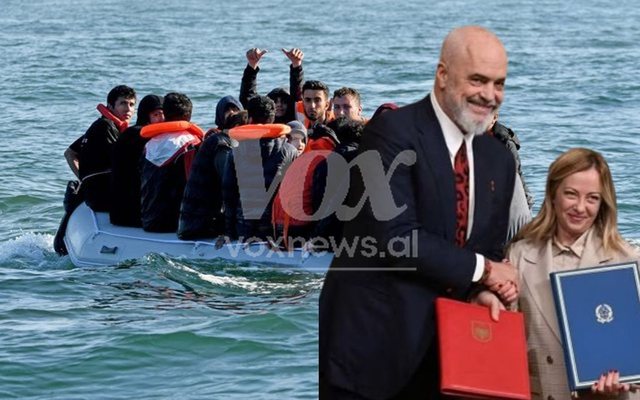
Amnesty International states that the agreement between Edi Rama and Italian Prime Minister Giordia Meloni is illegal and unenforceable.
A response on Amnesty International's official website states: People rescued at sea by Italian authorities, including those seeking asylum in Europe, are under Italian jurisdiction and cannot be transferred to another country before their claim is examined for asylum and individual situations.
Amnesty International's full response:
Commenting on the statement of November 6 regarding the agreement signed by the Prime Ministers of Italy and Albania, regarding the construction of two centers for the detention of persons rescued at sea by Italian ships, including persons seeking safety, Elisa de Pieri, researcher of Amnesty International for Europe, said:
'People rescued at sea by Italian authorities, including those seeking asylum in Europe, are under Italian jurisdiction and cannot be transferred to another country before their asylum claim and individual situation has been examined. It's very easy. This is an agreement on postponement, a practice prohibited by European and international standards and for which Italy has already been condemned by the European Court of Human Rights.
This agreement is illegal, void and must be cancelled.
Italy claims that people sent to Albania will remain under Italian jurisdiction, but the reality is that the agreement will be used to circumvent Italian, European and international rules with potentially devastating consequences for people seeking asylum who may be subject to detention. automatic and prolonged, and other violations of human rights, beyond the control of the Italian judicial authorities. The European Commission has already made it clear that European asylum rules cannot be applied outside the European Union.
Although the details of the deal are not yet known, a number of concerns are already emerging. Amnesty International calls on the Italian government to respect its obligations under international law regarding non-refoulement and the guarantee of asylum and calls on the European Commission to ensure that member states do not violate all international protection rules'.
Referring to the practice of sending refugees or asylum seekers to their own countries, or to others, where they may suffer ill-treatment.
Protection against refoulement is a fundamental right of refugees and asylum seekers.
Non-refoulement is a fundamental principle of international refugee law and, as part of customary international law, is binding on all states. The principle of non-refoulement is also provided for in European legislation and in Articles 18 and 19 of the Charter of Fundamental Rights of the European Union.
In 2018, the European Commission made it clear that extraterritorial application of European Union rules is currently not possible.
Italy has already been convicted of violating the principle of non-refoulement by the European Court of Human Rights in 2012 in the case of Hirsi Jamaa v. others.


